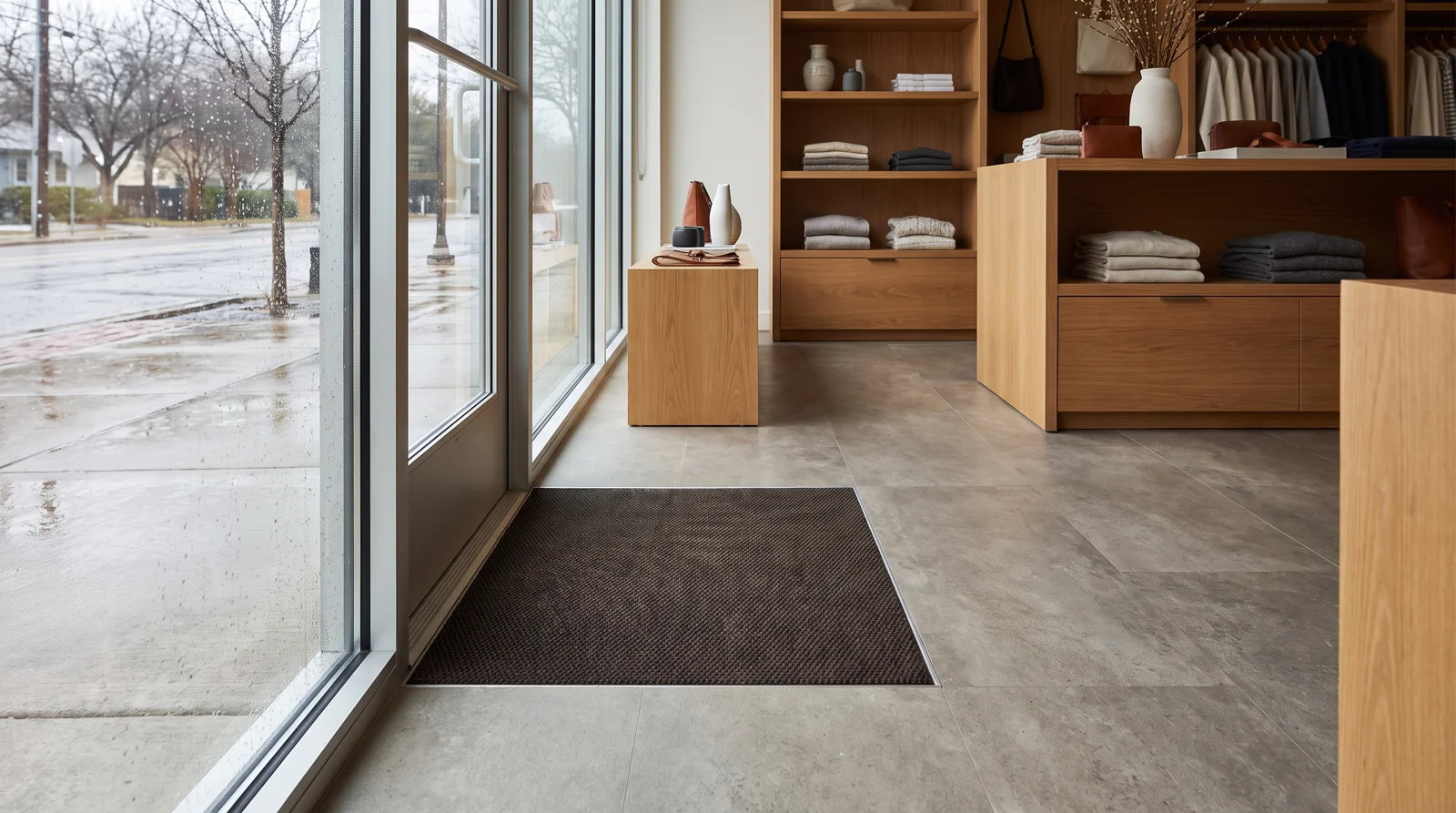
Quick answer: Start with soil scraping and absorbent entry matting, then choose the sales floor around the actual doorway exposure. Luxury vinyl tile needs written approval for that commercial use. Porcelain needs a suitable wet application classification. Ordinary carpet belongs beyond the main moisture capture zone. No material replaces prompt water removal.
1. Give the entrance more than a decorative mat
For a South Congress boutique or a Burnet Road shop, plan the winter 2026 entry before choosing the prettiest floor sample. Trace where customers step, stop to close an umbrella and turn toward the first display. An absorbent mat behind that display may miss the busiest path entirely.
Shaw Contract describes an entry system with successive zones that capture dirt and moisture before people reach the interior floor.1 Use that principle, not a promised capture percentage, to plan your doorway. Keep merchandise off the mat and allow normal steps across it. A retail flooring consultation should include the sidewalk approach and door swing, not just interior square footage.
2. Vinyl needs approval for this doorway
Luxury vinyl tile can give a shop a warm wood or quiet stone appearance. For this winter refresh, those are design recommendations, not verified Austin sales trends. Color comes after suitability.
MSI's combined warranty specifically excludes entryways from its light commercial definition, even though some small boutiques qualify as light commercial in other areas.2 That makes the exact collection, installation and location important. Do not approve an entry merely because a carton mentions commercial use.
The same guide excludes standing water from warranty coverage and calls for immediate drying of spills.2 Waterproof marketing is not permission to leave wet footprints unattended. Ask for the applicable commercial warranty, cleaning directions and mat backing approval. The commercial resilient flooring specifications guide can help frame that conversation without treating every vinyl product alike.
3. Porcelain needs a wet application decision
Porcelain is worth comparing when the entrance regularly sees damp shoes, but matte appearance alone does not establish traction. Ask for the manufacturer's declared application and wet traction information for the exact finish.
Daltile lists entry foyers among its interior wet examples. It also explains that laboratory friction measurements help compare products but cannot predict whether a person will slip. No floor tile is slip proof.3 A dry retail floor recommendation is not enough for a doorway expected to be walked on wet.
Review the commercial tile traction guide alongside the product sheet. Include grout, transitions and the cleaning method in the decision. Daltile warns that improper maintenance can leave slippery buildup and does not recommend polished surfaces where water exposure is expected.3
4. Separate entry carpet from comfort carpet
Purpose made entrance carpet and ordinary sales floor carpet have different jobs. Use the former to scrape and absorb. Consider the latter in a protected fitting or seating area after the main wet shoe path, rather than asking decorative carpet to manage the doorway.
Interface recommends exterior scraping mats and interior absorbent mats, plus more frequent cleaning in heavily used entrances. Its guidance also says to protect cleaned carpet until completely dry.4 Plan drying access and a replacement mat before opening, rather than trying to vacuum a saturated entrance with ordinary dry equipment.
A charcoal flecked entry surface beside warm neutral flooring is a restrained design option. It may make minor soil less conspicuous, but camouflage is not a cleaning standard. Keep spare modular pieces identified by product and color for future repairs.
5. Give staff a practical rain response
Before opening, check mat edges, the floor beneath removable mats and any water at the threshold. Keep umbrellas and temporary signs out of the customer route. Do not use loose towels as flooring protection.
During rain, assign a person to inspect the entrance and adjust inspection frequency to actual conditions. Replace a saturated removable mat with a clean, dry approved spare. Remove water promptly and restrict access to a wet cleaning area until it is ready for traffic.
MSI's combined care guide calls for immediate spill removal, immediate drying and no puddling.2 Interface likewise says not to allow traffic on carpet until dry.4 Put the selected products' instructions into one staff sheet. A generic housekeeping routine may not suit both surfaces.
6. Compare complete entry scopes
Bring these details to the sample and quote review:
- Photos of the approach, threshold and adjoining floor, plus the customer turning path.
- Samples of flooring, grout, transition and mat edge together under the shop lights.
- Written use approval, mat backing compatibility and cleaning instructions for each product.
- Separate allowances for removal, slab testing, preparation and any mat recess work.
- Door clearance, delivery cart access and the required time before reopening or cleaning.
Good means retaining suitable existing flooring and improving approved matting and staff care. Better adds a planned entry zone with stable transitions. Best may include a recessed system and coordinated replacement flooring when construction and exposure justify it. These are scope choices, not price tiers or safety guarantees.
Contact CC Floors Austin at 512-769-2292 with entrance photos and operating hours. Samples, supply, installed cost and the work window require project confirmation.
Related winter reading
- Oat, Taupe or Cool Gray LVP for an Austin Winter Entry
- Warm Mineral Flecks in Commercial Carpet Tile for Winter 2026
- Wood Look LVT and Carpet Zones for Austin Hospitality Spaces
Frequently Asked Questions
Is waterproof vinyl enough for a retail entrance?
No. Confirm written approval for the exact doorway and commercial use. MSI's combined guide excludes standing water from coverage and requires immediate spill drying, so matting and water removal still matter.
Is matte porcelain automatically safe with wet shoes?
No. Check the manufacturer's wet application classification and traction information. Daltile cautions that laboratory test results do not establish whether a slip can occur.
Can ordinary carpet tile replace an entrance mat?
Do not assume so. Ask for a product intended to capture entry soil and moisture, and keep ordinary comfort carpet beyond the principal capture zone. Maintain and dry both according to their instructions.
Should the whole shop floor be replaced this winter?
Not necessarily. Start with product suitability, existing condition and the wet shoe path. Better matting and a workable cleaning routine may be enough; new flooring needs a documented installation and reopening plan.
Sources and resources
- Shaw Contract Entryway Systems
- MSI Installation Warranty and Care Guide
- Daltile Slip Resistance Testing and Reading Test Results
- Interface Carpet Tile Maintenance Guidelines
Discuss your winter project
Thank you for considering CC Floors Austin. Request a project consultation, call 512-769-2292, text 713-444-4625, or email dan@austinflooringco.com. Confirm measurements, material selection, preparation and scheduling in a written scope before work begins.