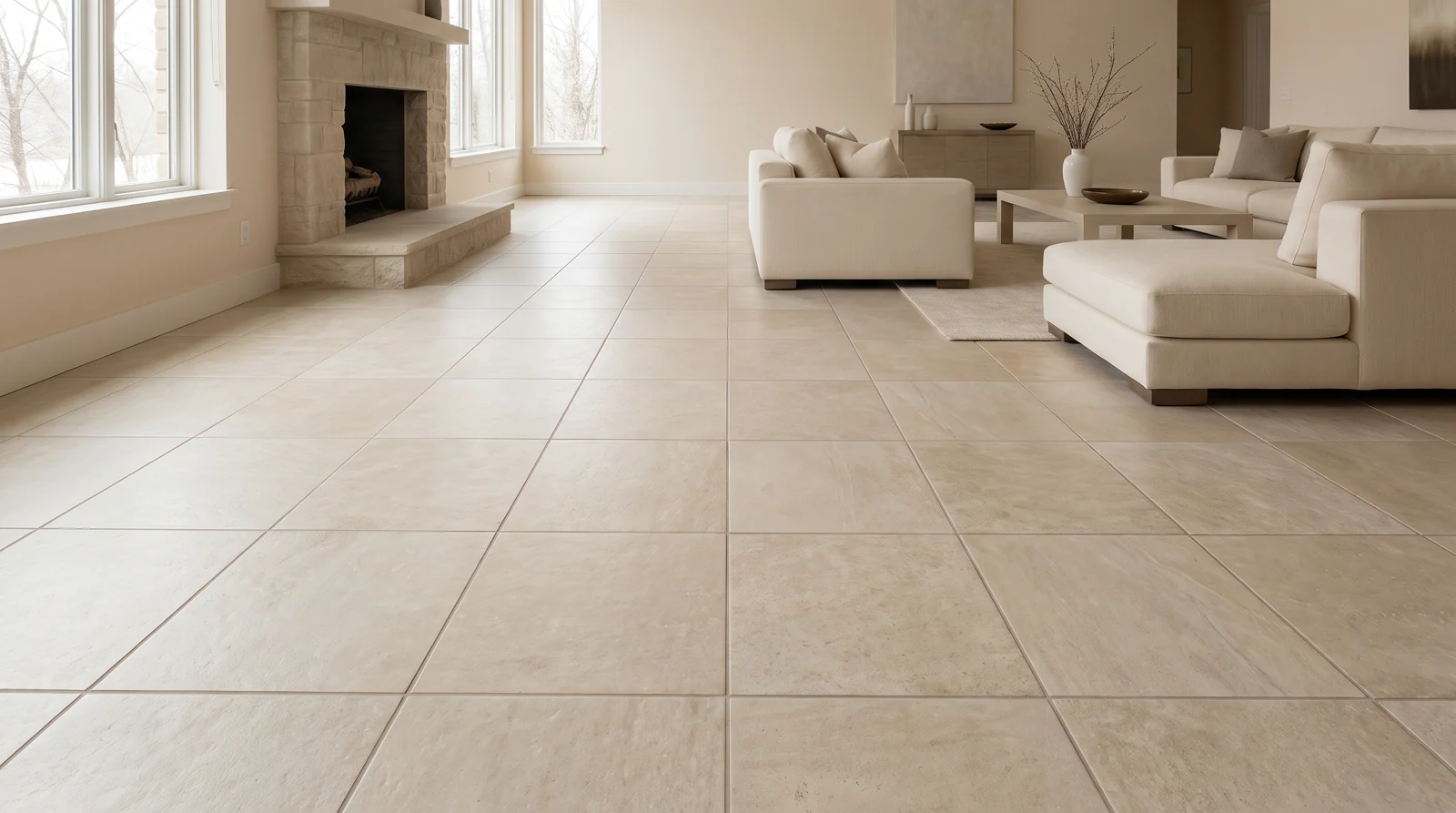
Quick answer: For a calmer porcelain floor, choose grout close to the tile’s background color, not its darkest vein. Approve a cured sample at the proposed joint width before ordering. Larger tiles can reduce the number of joints, but a quiet result still needs flat substrate preparation, sensible cuts and planned movement joints. Do not trade those requirements for an almost invisible grid.
1. Choose the grout relationship before the tile size
For an Austin living room refresh this winter, start with the view from the entry. Do you want to notice the stone pattern, the furniture or the tile grid? Warm limestone look porcelain with similar taupe grout is a design recommendation for the first two goals, not a claim about local best sellers.
Bedrosians’ January 2026 forecast identifies large porcelain formats and visual continuity as a design direction. That announcement does not measure Austin purchases or establish what will lead sales in early 2027.1
Joint contrast matters independently of size. A 12 by 24 inch tile with closely matched grout may look calmer than a 24 by 48 inch tile outlined in charcoal. CUSTOM’s color guide distinguishes similar grout colors, which create a uniform appearance, from contrasting colors that emphasize tile shapes.2 Compare both relationships before paying for a larger format.
2. Match the background, then test a cured joint
Lay several actual tiles together. Find the color that covers most of the face rather than matching an isolated brown streak. For a creamy tile, compare warm ivory and pale taupe. For a gray beige tile, compare neutral taupe against a cooler gray. These are starting points, not guaranteed matches.
Ask for a small grouted sample using the proposed product and joint width. CUSTOM warns that printed colors approximate grout and that the installed shade can vary with tile characteristics, job conditions and finishing technique.2 A cured sample is more useful than approving a color name on a screen.
In a Crestview living room, check the sample beside the existing brick hearth and painted baseboard. Stand at the entry as well as over the tile. Keep the sample through installation so the agreed color relationship remains clear.
3. Keep a real joint even with rectified edges
Rectified edges are not permission to butt tiles together. The installer needs to check actual tile size variation, the chosen pattern and the manufacturer’s joint requirements. CUSTOM’s published guidance calls for joints at least three times the variation in tile face dimensions, never less than 1/16 inch. The selected tile may require a wider joint.3
The useful question is not “Can you make it smaller?” Ask, “What width does this tile need, and can we make that width quieter with color?” Write the approved width and grout product into the scope.
Our tile installation service is a starting point for discussing the complete assembly. A photograph of another floor cannot establish the right spacing for your material.
4. Budget for flatness rather than hiding unevenness
A narrow, closely matched joint does not hide a raised tile edge. That height difference is called lippage. Long tiles need a sufficiently flat supporting surface before setting begins.
CUSTOM’s large format guidance specifies no more than 1/8 inch variation in 10 feet and 1/16 inch in 24 inches.3 These are flatness checks, not a demand to make every room perfectly level. Confirm the current requirements for the selected installation system.
For an existing Austin slab, arrange measurement after removal exposes the surface. Ask which high areas need grinding and which low areas need compatible patching. Put a preparation allowance and its approval process in the quote rather than treating every hidden condition as included. Discuss floor leveling and preparation before choosing a size that stretches the budget.
5. Make movement joints part of the color plan
A visually continuous floor still needs places to accommodate movement. The Tile Council of North America says every tile installation needs expansion and contraction provisions. Larger areas can require visible movement joints, and direct sunlight or moisture can require more frequent placement.4
In a Mueller room with broad patio glazing, ask the installer to identify these locations before approving the grid. Discuss compatible sealant or profiles and their available colors. A movement joint serves a different purpose from ordinary grout. Do not eliminate it to preserve a photograph’s uninterrupted appearance.
Use our movement joint guide for that conversation. Request a layout showing perimeter provisions, existing substrate joints and cuts at doorways. For offset rectangular patterns, check the tile maker’s limit; CUSTOM’s guidance limits running bond offset to 33 percent when an edge exceeds 18 inches.3
6. Bring this sample and quote checklist
- Bring several tiles, the cured grout sample and photographs of finishes you are keeping. Record the tile name, finish, grout product, color and approved width.
- Ask for a measured layout showing visible edge cuts, doorway transitions and movement joints. Confirm the selected tile’s suitability for the room’s use.
- Separate removal, surface preparation, setting materials, tile installation, grout, flexible joints and baseboard work in the written scope.
- Confirm material supply before demolition. Allow preparation products, mortar and grout their specified curing time before furniture returns.
For late 2026 work extending into early 2027, choose the floor as a complete installed system, not a winter trend deadline. Contact CC Floors Austin or call 512-769-2292 to discuss samples and a project specific quote. Supply, installed price and scheduling require confirmation.
Related winter reading
- Terracotta Look Porcelain Without a Rustic Overload
- High Contrast Tile in Austin: Keep It or Soften It for 2026?
- 2026 Paint Color Announcements and the Floors They Suit
Frequently asked questions
What grout color makes large porcelain tile look quieter?
Start with grout close to the tile’s main background color. Matching a dark vein instead usually emphasizes the grid. Approve the relationship with a cured sample.
Can rectified porcelain be installed without grout lines?
No. Rectified tile still needs joints that account for tile variation and manufacturer requirements. Use color to reduce their visual prominence instead of removing them.
Will bigger porcelain tiles hide an uneven floor?
No. Large format tile needs substrate flatness preparation; it does not replace it. Have the exposed surface measured before approving the preparation scope.
Can matching grout replace a movement joint?
No. Movement joints accommodate expansion and contraction that ordinary grout does not resolve. Choose compatible colors without deleting required joints.
Sources and resources
- Bedrosians Emerging Tile Trends for 2026, January 2, 2026
- CUSTOM Grout Solutions Color Card, June 2025 revision
- CUSTOM Installing Large Format Tile Frequently Asked Questions
- Tile Council of North America Movement Joint Placement
Discuss your winter project
Thank you for considering CC Floors Austin. Request a project consultation, call 512-769-2292, text 713-444-4625, or email dan@austinflooringco.com. Confirm measurements, material selection, preparation and scheduling in a written scope before work begins.